Chapter I • The Etymological Truth

Beyond the Colonial Horizon: Why "Hindu" Was an Exonym

To understand who we are, we must first liberate ourselves from the linguistic cages constructed by outsiders. Nowhere in the four Vedas, nowhere in the hundred and eight Upanishads, nowhere in the Ramayana, Mahabharata, or the Bhagavad Gita will you find the word "Hindu".

The word did not originate as a sacred spiritual term. It began as a geographical and phonetic exonym. Ancient Persians, gazing eastward toward the great northern river Sindhu (सिन्धु — the Indus), pronounced the Sanskrit sibilant "Sa" as an aspirate "Ha". Thus, the Sindhu became the Hindu, and the people dwelling beyond its fertile banks were referred to geographically as the inhabitants of *al-Hind*. The ancient Greeks echoed this as Indoi, from which the modern word *India* was ultimately derived.

Centuries later, during the rule of the British Raj, colonial administrators faced an administrative puzzle. Accustomed to the European Abrahamic paradigm — where religion required a single historical prophet, a single centralized holy book, a rigid canon of commandments, and a formal institutional clergy — they encountered on the Indian subcontinent an infinite, decentralized spiritual ocean.

To categorize, count, and govern this civilization in their decennial imperial censuses, the British codified this living ocean into an organized institutional "-ism": "Hinduism". In doing so, they compressed a cosmic science of being into the narrow political and legal constraints of Western religious terminology.

The Historical & Linguistic Evolution

1
Sindhu (सिन्धु)
Vedic Antiquity

The primordial sacred river in the northwest cradle of Vedic civilization.

2
Hindu / Indos
Persian & Greek

Phonetic shift (S → H). A geographical label for anyone living east of the river.

3
"Hinduism"
British Raj (18th-19th C.)

Colonial bureaucratic categorization into an organized, uniform "-ism" for imperial control.

4
Sanātana Dharma
Anādi • Ananta

The true, beginningless and endless cosmic natural law that sustains creation.

What Does "Sanātana Dharma" Truly Mean?

The authentic self-designation preserved by our rishis is Sanātana Dharma (सनातन धर्म).

  • Sanātana (सनातन): That which has no historical birth date (*Anādi* — without beginning) and no terminal expiration date (*Ananta* — without end). Just as the law of gravity operates whether or not a human acknowledges it, Sanātana truths are intrinsic to the fabric of reality.
  • Dharma (धर्म): Derived from the Sanskrit root Dhri (धृ), meaning "to uphold, to sustain, to nourish". Dharma is that which holds the cosmos together — righteousness, cosmic harmony, moral integrity, and sacred duty.

Sanātana Dharma is not a creed you sign up for; it is an exploration of the truth of your own being. It has no fear of science, no fear of philosophy, and no fear of doubt. Indeed, doubt is the very stepping stone of the Vedic quest.
Chapter II • The Fountainhead of Revelation

The Four Sacred Vedas (चत्वारो वेदाः)

Known as Shruti (that which was directly perceived in the highest states of meditative absorption by the Rishis), the Vedas are the sonic blueprints of existence.

10,552 Mantras • 1,028 Suktas

Rigveda (ऋग्वेद)

The Veda of Cosmic Wonder & Primordial Light

The oldest philosophical monument known to humanity. The Rigveda does not approach the divine with trembling fear, but with radiant wonder. It salutes the dawn (*Ushas*), the solar radiance (*Savitr*), the celestial winds (*Vayu*), and the primordial flame (*Agni*).

The Nasadiya Sukta (Creation Hymn - RV 10.129): "Then there was neither non-existence nor existence... Who verily knows and who can here declare it, whence it was born and whence comes this creation? Perhaps it fashioned itself, or perhaps it did not. Only the Overseer in highest heaven knows... or perhaps even He knows not!"
Essential Key: Metaphysical Inquisitiveness Gayatri Mantra Origin
1,875 Verses • Melodic Metric

Samaveda (सामवेद)

The Veda of Sacred Melody & Ecstasy

The fountainhead of Indian classical music, Ragas, and the spiritual science of Nāda Brahma (God as Divine Sound). It sets the illuminated verses of the Rigveda to musical scales and sacred metre (*Chhandas*).

Lord Krishna's Declaration (Gita 10.22): "वेदानां सामवेदोऽस्मि — Among all the four Vedas, I am the Samaveda." It is the parent of devotional kirtan, bhajan, dhrupad, and sacred sonic elevation.
Essential Key: Nāda Brahma & Bhakti Melody Fountain of Ragas
Shukla & Krishna Branches

Yajurveda (यजुर्वेद)

The Science of Action, Sacrifice & Surrender

The guidebook of cosmic exchange and consecrated living. While externally it outlines the liturgy of *Yajna* (sacred fire rituals), internally it teaches that every breath, thought, and deed must become a selfless offering to the universe (*Nishkama Arpana*).

Sri Rudram & The Peace Mantras: Contains the immortal *Sri Rudram* (Chidambaram hymn of cosmic omnipresence) and the foundational universal prayer: "इमं मे गङ्गे यमुने... Om Shanti Shanti Shanti."
Essential Key: Karma as Living Sacred Yajna Source of Sri Rudram
20 Kandas • 730 Hymns

Atharvaveda (अथर्ववेद)

The Veda of Healing, Life & Ecological Harmony

The everyday bridge between transcendence and bodily wellness. The Atharvaveda is the cradle of Ayurveda (the science of longevity), botanical pharmacology, home blessings, societal ethics, and deep ecological reverence.

The Prithvi Sukta (Hymn to Mother Earth - 12.1.12): "माता भूमिः पुत्रोऽहं पृथिव्याः — Earth is my mother; I am her devoted child. May she pour forth for us her wealth of life and sustain all beings with unshakeable peace."
Essential Key: Sacred Ecology & Longevity Roots of Ayurveda
Chapter III • The Living Epics & Vedānta

The Guiding Lights of Sanātana Consciousness

From the pinnacle of Upanishadic non-dual philosophy to the visceral battlefields of the Gita and the righteous epic of Sri Rama.

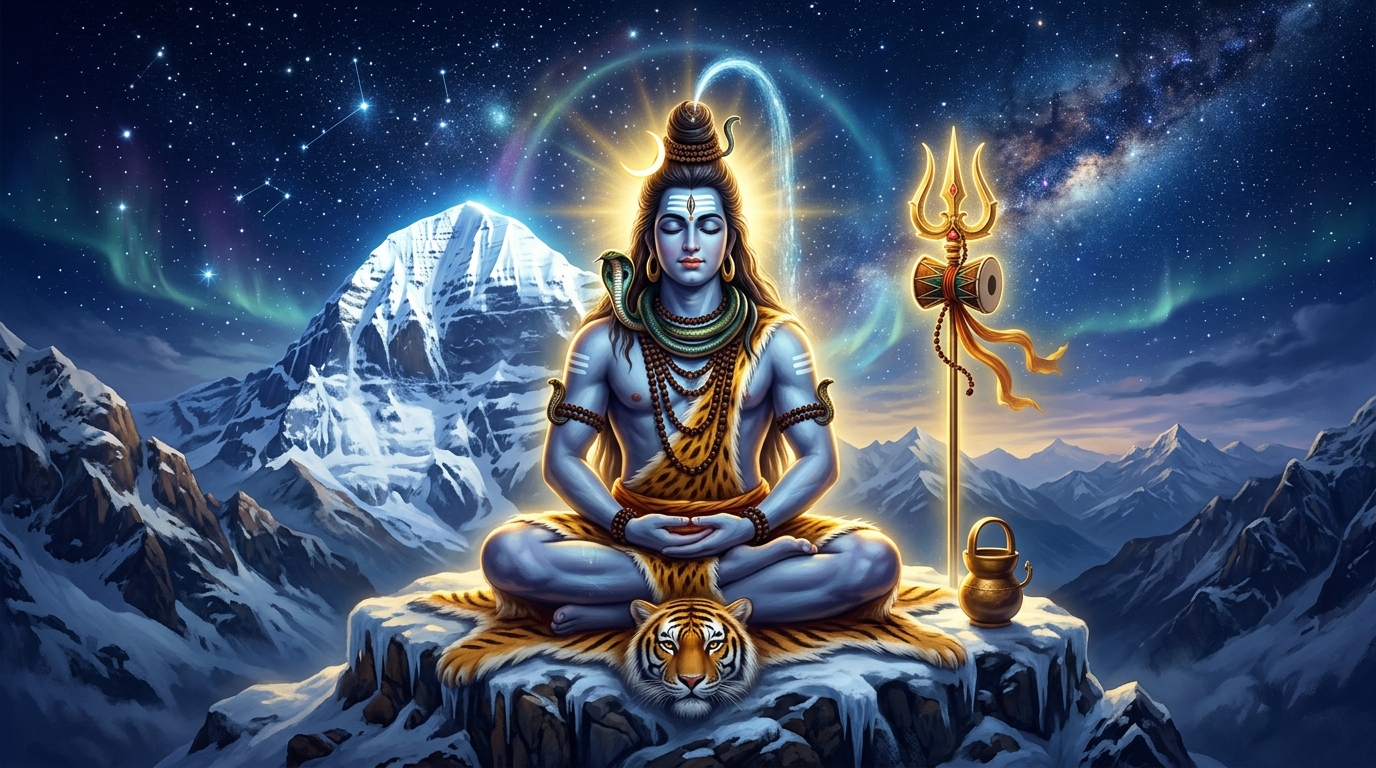
Lord Shiva in Deep Cosmic Meditation
Mahadeva Shiva • The Formless Absolute & Inner Witness
The Summit of Vedanta

The Upanishads (उपनिषद्)

Where external rituals dissolve into the direct realization of the Self. The word *Upa-ni-shad* signifies "sitting down near an enlightened master" to receive the highest truth.

Tat Tvam Asi (तत् त्वम् असि) — Chandogya Upanishad

"You are That. The immortal divine ground of the universe is identical to your deepest consciousness."

Aham Brahmāsmi (अहं ब्रह्मास्मि) — Brihadaranyaka Upanishad

"I am the infinite Brahman. Existence is not fragmented; it is a single, continuous ocean of awareness."

The Song of Sovereign Duty

The Bhagavad Gita (श्रीमद्भगवद्गीता)

Delivered not in a cloistered monastery, but on the dust and clash of the battlefield of Kurukshetra. It is the definitive manual for living heroically in an imperfect world without losing your spiritual anchor.

Sri Krishna reveals that true spiritual realization is not passive escape, but dynamic mastery. Through Nishkama Karma (action without selfish clinging to results), Jnana Yoga (intellectual discernment), and Bhakti Yoga (loving self-surrender), one achieves the state of the Sthitaprajna — one whose intellect remains unshakeable in joy and sorrow alike.

Gita 2.47 (The Universal Code of Duty): "कर्मण्येवाधिकारस्ते मा फलेषु कदाचन । मा कर्मफलहेतुर्भूर्मा ते सङ्गोऽस्त्वकर्मणि ॥"
"You have a right to your sacred labor alone, never to its fruits. Let not the fruits of action be your motive, nor let your mind attach itself to inaction."
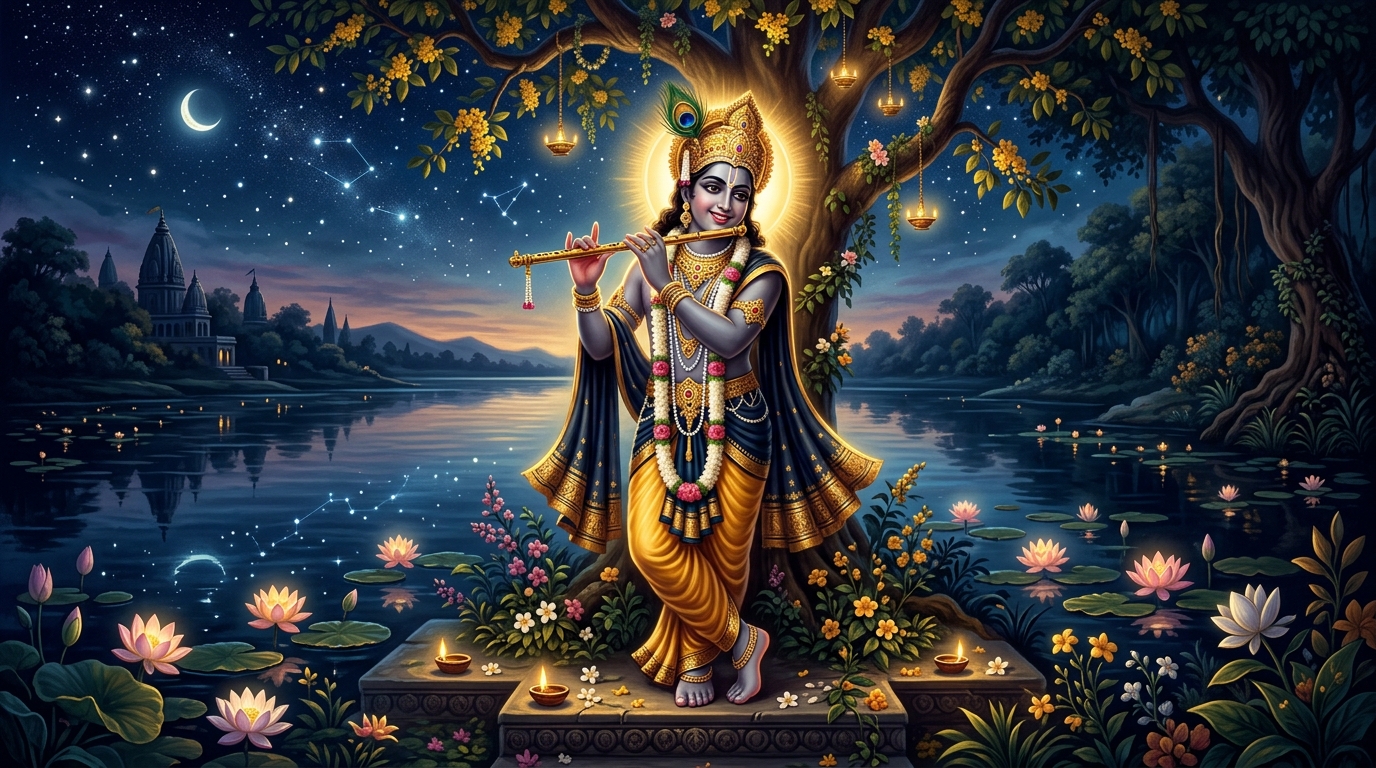
Lord Krishna with Sacred Flute
Yogeshwara Krishna • Teacher of the Universe (जगद्गुरु)
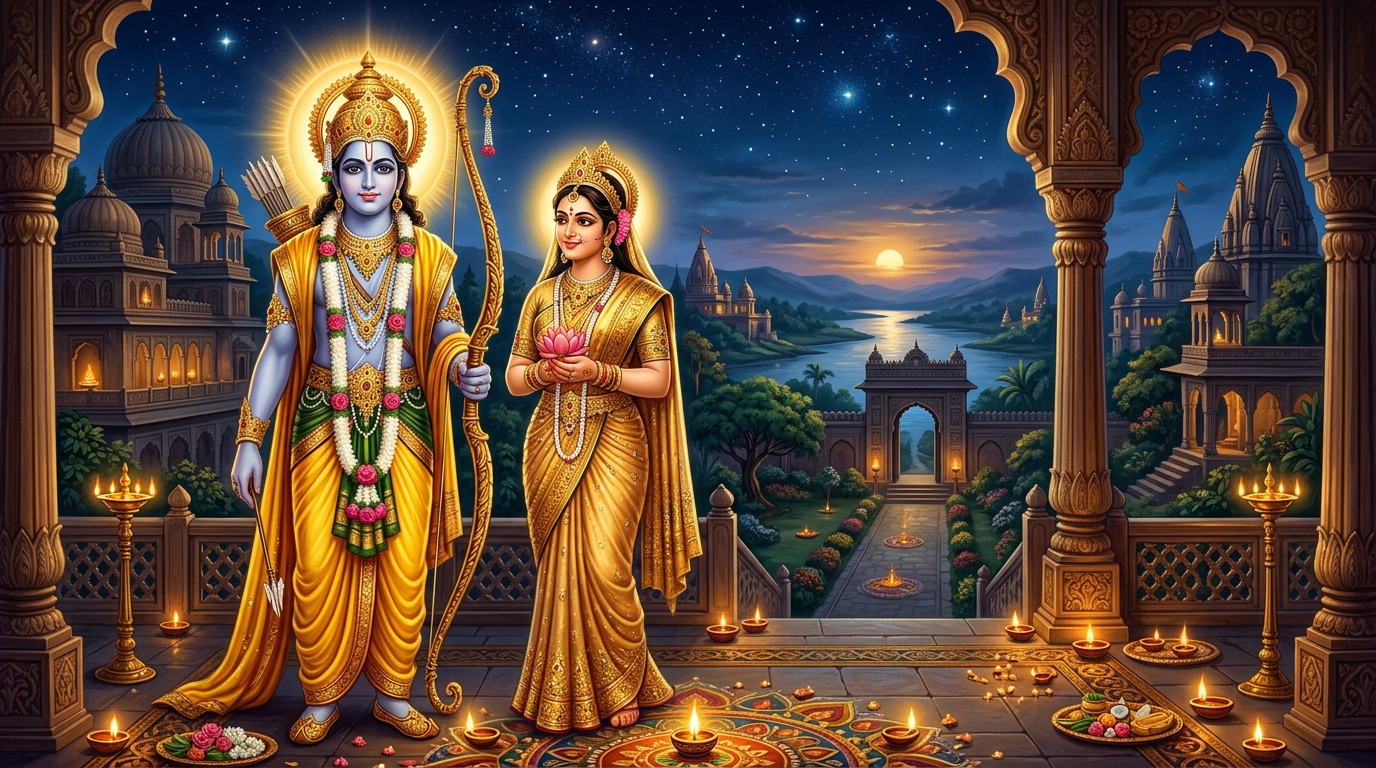
Maryada Purushottama Lord Rama with Sita and Lakshmana
Sri Rama • The Living Architecture of Righteousness
The Living Embodiment of Dharma

The Ramayana (रामायण)

From the Sanskrit meter of Maharishi Valmiki to the divine Awadhi nectar of Goswami Tulsidas's *Ramcharitmanas*, the Ramayana is not merely an epic story — it is Dharma demonstrated in blood, tears, honor, and joy.

Sri Rama is revered as Maryada Purushottama (मर्यादा पुरुषोत्तम) — the supreme exemplar of ethical bounds. Through fourteen years of forest exile, unshakeable loyalty to his father's vow, compassionate alliance with Sugriva and the Vanara army, and the destruction of tyrannical Ravana, Rama demonstrates that righteousness must never be surrendered, even in the darkest wilderness.

रघुकुल रीति सदा चलि आई । प्रान जाहुँ बरु बचनु न जाई ॥

"Such is the eternal tradition of the Raghu lineage: life itself may be relinquished, but a righteous pledge given in truth shall never be broken."

Chapter IV • The Eternal Principles

The Five Pillars of a Sanatani Life

Sanātana Dharma is not dogma; it is an active spiritual technology for personal evolution and communal harmony.

1. Satya (सत्य) • Truth

Truth is not an ideology; it is reality as it is. Satyameva Jayate — Truth alone triumphs. Living in truth frees the mind from guilt, deceit, and vanity.

2. Ahimsa & Karuna • Non-Injury

Reverence for all life forms. Seeing the divine spark (*Atman*) in humans, animals, forests, and rivers alike.

3. Karma & Rebirth • Moral Accountability

Every intention and action leaves an energetic imprint. We are the architects of our own destiny, lifetime after lifetime.

4. Vasudhaiva Kutumbakam • Universal Family

"अयं निजः परो वेति गणना लघुचेतसाम्" — Only small minds distinguish between mine and theirs; for the noble, the entire universe is one family.

5. Ekam Sat Vipra Bahudha Vadanti

Truth is One; the wise express it in diverse ways (Rigveda 1.164.46). This is why a Sanatani never declares other paths to be damnable heresies.

6. Moksha (मोक्ष) • Ultimate Liberation

The final goal of human existence: to break the cycle of suffering, transcend ignorance (*Maya*), and unite with infinite Satchitananda.

Chapter V • Sociological Truth & Sacred Calling

The Science of Super-Specialization & What It Truly Means to Be a Brahmin

For over two centuries, a profound culture of misinformation has clouded the understanding of ancient Indian social architecture. What modern polemics reduce to a rigid, oppressive "caste system" was originally a sophisticated civilizational blueprint of organic super-specialization and dynamic division of labor.

Today, modern society marvels at hyper-specialization — we construct separate universities, research think tanks, defense academies, and corporate financial ecosystems. Yet millennia ago, our rishis recognized that no great civilization can endure if every individual attempts to perform every function simultaneously. Society was envisioned as a singular, harmonious living organism (*Virāt Purusha*), requiring four coordinated limbs:

1. The Head • Brahmin Knowledge & Ethics

Philosophers, educators, epistemologists, and guardians of sacred ceremony and sound.

2. The Arms • Kshatriya Governance & Defense

Protectors of the vulnerable, administrators of justice, military defenders, and ethical rulers.

3. The Thighs • Vaishya Commerce & Sustenance

Entrepreneurs, merchants, agronomists, and custodians of trade, capital, and supply chains.

4. The Feet • Shudra Applied Craft & Groundwork

Artisans, engineers, master craftsmen, builders, and the vital foundation of all physical production.

Crucially, in the authentic Vedic paradigm, no organ was superior or inferior to another. Can the head survive without the feet? Can the feet walk without the eyes? Every role was an indispensable manifestation of the divine whole.

Scriptural Proof: Guna & Karma, Not Hereditary Chains

Bhagavad Gita 4.13 • Aptitude & Action

"चातुर्वर्ण्यं मया सृष्टं गुणकर्मविभागशः ।"

Sri Krishna explicitly states that the fourfold order was instituted according to the divisions of Guna (innate psychological aptitude) and Karma (chosen profession and action). He did not say Janma-vibhāgaśaḥ (by birth lineage).

Rigveda 9.112.3 • Occupational Diversity Within One Home

"कारुरहं ततो भिषगुपलप्रक्षिणी नना । नानाधियो वसूयवोऽनु गा इव तस्थिमेन्द्रावेन्दो परि स्रव ॥"

The Vedic rishi proclaims: "I am a poet/composer of hymns; my father is a physician (healer); my mother is a grinder of corn with stone. Following diverse callings, we dwell together harmoniously." This ancient hymn dismantles the myth of frozen generational caste silos.

The Colonial Codification of "Caste"

The word "Caste" is neither Sanskrit nor Hindi. It derives from the Portuguese word casta (meaning "breed, unmixed race, or lineage"), introduced by European travelers in the 16th century. In 1901, the British colonial administration under Sir Herbert Risley used the decennial census to forcefully categorize and freeze thousands of localized, fluid trade guilds (*Jatis*) into rigid legal hierarchies to administer imperial control, forever cementing a false rigidity upon a living civilization.

The Authentic Calling of a Brahmin: A Burden of Austerity, Not Power

A true Brahmin possessed no royal army, wore no crown, and amassed no private fortune. Strict Vedic law forbade a Brahmin from hoarding wealth. Their sole authority was rooted in moral purity, ascetic scholarship (*Tapas*), and selfless service. They were governed by the Shat-Karma (षट्कर्म — The Six Inviolable Duties):

1. Adhyayana (अध्ययन)

Lifelong scholarship, deep research, and rigorous contemplation of science, language, and scripture.

2. Adhyāpana (अध्यापन)

Educating the youth freely without commercial greed, transmitting wisdom from generation to generation.

3. Yajana (यजन)

Performing sacred rituals, meditations, and prayers for cosmic equilibrium and universal peace.

4. Yājana (याजन)

Guiding families, seekers, and society through sacred life ceremonies, sacraments, and transitions.

5. Dāna (दान)

Generously giving charity, blessings, intellectual insight, and emotional shelter to all who seek it.

6. Pratigraha (प्रतिग्रह)

Accepting only the bare minimum voluntary gifts required for humble sustenance; never seeking luxury.

AD
Personal Reflection

Why I Stand as a Brahmin • By Anand Dubey

"As a Brahmin in the modern world, I carry no sense of superiority; I carry an ancient debt of sacred duty (*Rishi Rina*).

I am simply the keeper of knowledge, the master of Sanatani ceremonies, and the educator of the young.

When the contemporary world champions super-specialization — honoring professors, curators, ethicists, and research scholars — it is merely rediscovering what Sanātana Dharma architected eons ago. To dedicate one's life to the preservation of truth, to maintain the flawless resonance of sacred mantras, to educate our youth in values and intellect, and to patronize devotional music that elevates the soul — that is not privilege. That is an eternal, joyful responsibility."
Chapter VI • The Warrior-Sage Lineage

The Sacred Martial Heritage: From Dhanurveda & Kalaripayattu to the Shaolin Temple

There is an essential, awe-inspiring category of knowledge that I carry in my DNA — one that the modern world has forgotten was nurtured, codified, and guarded by Sanatani Brahmins and Rishis: the sacred martial sciences.

In the popular Western imagination, spirituality is often falsely depicted as passive retreat from the physical world. But in the Vedic worldview, mind and body, spirit and defense, were united in absolute harmony. Alongside the four main Vedas, our rishis established four Upavedas (applied sciences): Ayurveda (Medicine), Gandharvaveda (Music & Acoustics), Sthapatyaveda (Architecture), and Dhanurveda (धनुर्वेद — The Science of Combat, Weaponry & Strategic Defense).

Throughout our sacred history, the supreme preceptors of warfare were not unthinking mercenaries; they were the **Rishi-Yoddhas (Sage-Warriors)** — masters whose spiritual discipline (*Samyama*) ensured that physical power was always restrained by moral conscience:

Bhagavan Parashurama

Father of Kalaripayattu

The immortal warrior-sage who consecrated the southwestern coast of Bharat (Kerala and Konkan) and established the original 108 Kalaris — the consecrated training grounds of Kalaripayattu.

Acharya Drona & Kripa

Masters of Kurukshetra

Revered Brahmin preceptors of the Mahabharata who instructed the royal princes in the supreme arts of archery, divine Astras, tactical formations (Vyuhas), and hand-to-hand combat.

Maharishi Agastya

Siddha & Varma Kalai

Revered in the South as the progenitor of Varma Kalai (the science of vital points) and Silambam, synthesizing deep Siddha medical pharmacology with lethal and curative precision.

Kalaripayattu & Marma Shastra: The Anatomical Science of Life & Death

Historians and martial researchers acknowledge Kalaripayattu as the oldest living martial art in the world. But it was never merely a system of physical combat. It was an advanced clinical extension of Ayurveda and Yogic physiology:

The 108 Marma Points (मर्म स्थान)

A Kalari master had to memorize the 108 vital intersection points (*Marmas*) across the human anatomy — junctions where nerves, blood vessels, ligaments, bones, and vital life-energy (*Prana*) intersect.

Strict oaths of spiritual initiation (*Deeksha*) were required before this knowledge was imparted. Why? Because the exact same pressure point that can paralyze, disarm, or instantly neutralize an attacker is the very point an Ayurvedic healer stimulates to resuscitate a dying patient, relieve nervous collapse, or heal internal trauma. In the hands of a sage, combat and medicine were two sides of the same sacred coin.

The Historic Transmission

From Kanchipuram to the Shaolin Temple: The Legacy of Bodhidharma

The global lineage connecting Indian martial arts to China, Japan, and the world is an authenticated historical reality anchored in a single towering figure: Bodhidharma (known throughout East Asia as Damo 菩提達摩).

Born in the 5th–6th century CE in the scholarly royal and spiritual seat of Kanchipuram (Tamil Nadu, South India), Bodhidharma was deeply trained in both Dhyāna (profound meditative absorption) and the southern martial disciplines of Kalaripayattu and Varma Kalai.

Around 527 CE, following ancient maritime and Himalayan pilgrim routes, Bodhidharma arrived at the Shaolin Monastery (少林寺) on the sacred Song Mountain in northern China. Classical records (including the Record of the Buddhist Monasteries of Luoyang and the Anthology of the Patriarchal Hall) state that he found the resident monks physically frail, emaciated, and unable to endure the rigor of prolonged seated meditation.

To transform their physical vessels, Bodhidharma instructed them in dynamic movement routines adapted directly from Indian Kalaripayattu animal postures (the Tiger, Leopard, Crane, Snake, and Dragon) and Yogic breath regulation (*Pranayama*):

  • The Eighteen Arhat Hands (Shi Ba Luo Han Shou 十八羅漢手): The founding seventeen combat and health exercises that formed the direct genetic root of Shaolin Kung Fu.
  • The Muscle/Tendon Changing Classic (Yijin Jing 易筋經): Internal energetic cultivation designed to infuse the physical tendons with uninterrupted Pranic force.
  • From Dhyāna to Chan and Zen: Simultaneously, Bodhidharma’s transmission of Sanskrit Dhyāna (meditation) became Chan in China, and later migrated to Japan as Zen.

From Shaolin, these arts spread across China, migrated to Okinawa, gave birth to Karate (originally written as "Tang/Chinese Hand"), and laid the foundation for the entire East Asian martial landscape. At its fountainhead sits the ancient Indian science of Kalaripayattu and Dhanurveda.

AD
Personal Reflection

Carrying the Warrior-Sage Heritage in My DNA

"This martial heritage is not an abstract theory to me; it is an instinct carried in the very marrow of my DNA.

Our ancestors did not separate intellectual brilliance from physical courage. The true Sanatani ideal was the Rishi-Yoddha (The Sage-Warrior): one who cultivates the mind to perceive cosmic truth, and conditions the body to defend Dharma with unyielding strength.

We do not learn to fight out of malice or conquest. We master the sword so thoroughly that we never need to draw it in vanity. Non-violence (*Ahimsa*) is not the cowardice of the weak; it is the conscious, divine restraint of the powerful. As our timeless motto declares: शास्त्रे च शस्त्रे च प्रवीणाः — Masters of both the sacred scripture and the noble art of defense."
Chapter VII • The Great Colonial Fracture

One Sacred Banyan Tree: Dismantling the Colonial Divide Between Sanatanis, Buddhists, Jains & Sikhs

Beyond inventing the artificial rigidity of the modern "caste system", the British colonial enterprise enacted a far deeper, more insidious civilizational tragedy: they fractured the single, indivisible spiritual ocean of Sanātana Dharma into mutually exclusive, rival religious camps.

Governing over three hundred million Indians was an impossibility for a handful of foreign imperial officers unless they weaponized the ancient imperial playbook: Divide et Impera (Divide and Rule). Accustomed to the bloody sectarian wars of European history, colonial census administrators drew rigid boundary lines across a culture that had lived as an interconnected family for millennia.

They declared "Hinduism", "Buddhism", "Jainism", and "Sikhism" to be separate, conflicting faiths. Yet in the living reality of Bharat, these were never alien religions — they were Darshanas (illuminated perspectives) blooming from the very same primordial Sanatani root, sharing the same spiritual grammar: *Karma, Dharma, Samsara, Moksha, Dhyana, and Ahimsa*.

Gautama Buddha: The Great Sanatani Reformer

Prince of the Ikshvaku Solar Dynasty (Suryavansha)
"एष धर्मः सनातनः"

Siddhartha Gautama was born into the sacred Ikshvaku Solar Dynasty — the exact same noble royal lineage as Maryada Purushottama Sri Rama. He never claimed to invent a new religion or repudiate the eternal truth. In the Nagara Sutta (Samyutta Nikaya 12.65), the Buddha declares:

"I have not invented an uncharted path. Just as a traveler in a dense forest discovers an ancient, forgotten highway trodden by enlightened beings of the past, so too have I walked and revealed that ancient, timeless road."

In the sacred Dhammapada (Verse 5), the Buddha’s most famous moral decree is literally rooted in the Sanatani identity:

न हि वेरेन वेराणि सम्मन्तीध कुदाचनं । अवेरेन च सम्मन्ति एस धम्मो सनन्तनो ॥
"Hatred never ceases through hatred in this world; through love and compassion alone does it cease. This is the Eternal Law — Esa Dhammo Sanantano (एष धर्मः सनातनः)."

Throughout the Brahmana Vagga of the Dhammapada, Buddha does not attack the concept of a Brahmin; rather, he restores it to its pure Vedic grandeur — defining a true Brahmin not by arrogant birth, but by mastery over anger, sensory craving, and ego. For millennia, Sanatani tradition has venerated Bhagavan Buddha as the 9th Avatara of Vishnu, the embodiment of supreme compassion (*Karuna*).

Bhagavan Mahavira & The Jain Tradition

The Shramana Jewel of the Vedic Forest
"अहिंसा परमो धर्मः"

Bhagavan Mahavira was the 24th Tirthankara in a lineage of ascetic masters that stretches into the mists of Vedic antiquity. The 1st Tirthankara, Bhagavan Rishabhadeva, is celebrated with profound reverence in the Srimad Bhagavatam (5th Canto) and the Vishnu Purana as a divine Avatara of Lord Vishnu who renounced his kingdom to embody perfect spiritual detachment.

The foundational motto of Jainism — "Ahimsa Paramo Dharmah" (Non-violence is the supreme Dharma) — is found verbatim in the Mahabharata (Shanti Parva 116.37). For thousands of years across Gujarat, Rajasthan, and Karnataka, Jains and Vaishnavas intermarried seamlessly, worshipped at the same tirthas (Mount Kailash, Girnar, Shatrunjaya), and shared the identical code of yogic ethics (*Yamas and Niyamas*).

Shri Guru Gobind Singh Ji & The Sikh Gurus

The Supreme Shield of Dharma & Devotee of Mahakal
"सकल जगत मो खालसा पंथ गाजे"

Perhaps no greater injustice was committed by colonial historiography than portraying the Sikh tradition as alien or opposed to Sanātana Dharma. The Sikh Gurus arose as the supreme sword, shield, and martyr-protectors of Sanatana civilization against tyrannical foreign oppression.

When Mughal zealots sought to forcibly convert the Kashmiri Brahmins, the Ninth Master, Guru Tegh Bahadur Ji, made the supreme sacrifice, giving his life at Chandni Chowk in Delhi to defend the sacred thread (*Janeu*) and sacred mark (*Tilak*) of his fellow countrymen:

"तिलक जंजू राखा प्रभ तां का । कीनो बडो कलो महि साका ॥"
"He gave his head to preserve the Tilak and Janeu of Dharma; in this dark age of Kali, he wrought a wondrous, immortal deed." — Bachittar Natak

The Tenth Master, Shri Guru Gobind Singh Ji, was the greatest warrior-devotee of his era. In his monumental scripture, the Dasam Granth, Guru Gobind Singh Ji composed earth-shaking devotional hymns in sublime Braj Bhasha:

  • Chandi Charitar & Chandi di Var: Fiery, magnificent poetry worshipping Maa Chandi (Durga) destroying demons, invoking the warrior spirit (*Bir Ras*) to eradicate oppression.
  • Rudra Avtar & Krishna Avtar: Detailed, reverent narrations of the divine deeds of Shiva, Rudra, and Krishna.
  • The Prayer to Shiva / The Divine Light: The immortal warrior pledge:
    "देह सिवा बरु मोहि इहै सुभ करमन ते कबहूं न टरों ॥ न डरों अरि सो जब जाइ लरों निसचै करि अपनी जीत करों ॥"
    Deh Shiva Bar Mohi Ihai, Subh Karman Te Kabhoon Na Taron | Na Daron Ari So Jab Ja-e Laron, Nischai Kar Apni Jeet Karon ||
    "O Shiva / Divine Consciousness, grant me this boon: that I may never hesitate from righteous action. That I fear no enemy when I enter the battlefield, and with firm faith, achieve righteous victory!"

In the Sri Guru Granth Sahib, the sacred name of Hari is invoked over 8,000 times, the name of Rama over 2,500 times, alongside Govind, Gopal, Murari, and Damodar. For centuries in Punjab, the eldest son of a Sanatani Hindu family was gratefully consecrated into the Khalsa (*Sant-Sipahi*) to defend the community. They were one flesh, one blood, one Dharma.

AD
Civilizational Manifesto

The Re-unification of the Sanātana Family • By Anand Dubey

"We are not rival factions competing in an imperial marketplace of religions. We are the branches, the flowers, and the fruits of the same primordial Vedic banyan tree.

Gautama Buddha is our supreme teacher of Karuna; Bhagavan Mahavira is our mirror of spotless Ahimsa; and Shri Guru Gobind Singh Ji is the immortal lion-hearted shield of our faith and devotion.

When colonial rulers divided us with census pens, they attempted to amputate our civilizational limbs. But our shared mantras, our shared blood, our shared sacred rivers, and our shared reverence for the Divine can never be severed. To be a Sanatani is to embrace the entire sacred family of Bharat with open arms, seeing one eternal truth beating in every heart."

The Sanatani Pledge

"I honor the Rishis who inquired into the cosmos. I honor the melody of the Samaveda. I honor the duty of the Gita and the grace of Sri Rama. I bow to the divine within every being. I am a Sanatani."